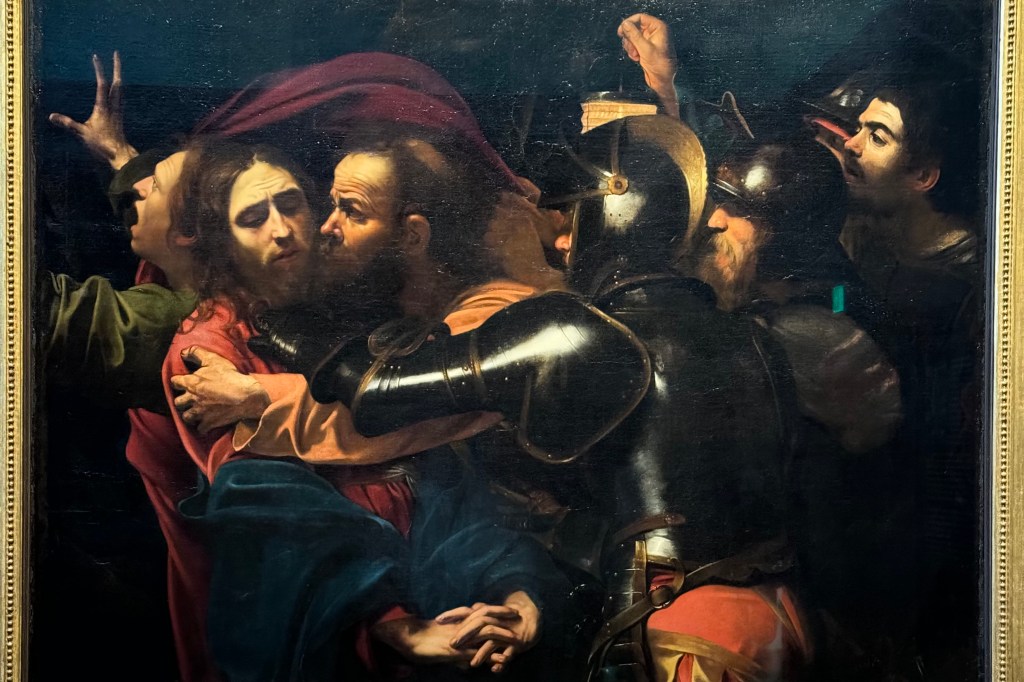
“P’resa di Cristo nell’orto or Cattura di Cristo”
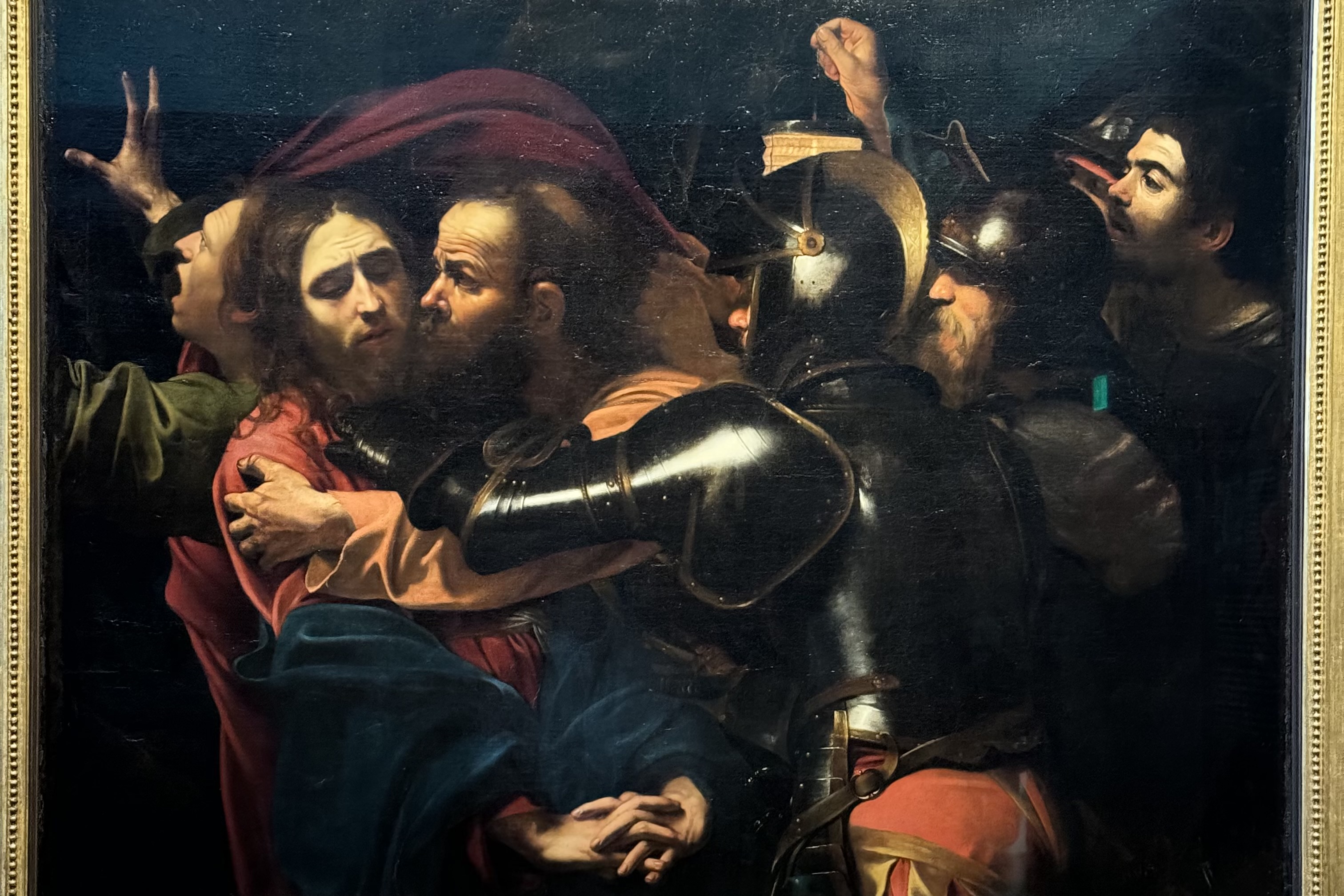
This painting moved me, and I was privileged to see it at the Ulster Museum in Belfast. This is Caravaggio’s The Taking of the Christ.
I spent some time in front of this painting and admiring this masterpiece by the “maestro.” “P’resa di Cristo nell’orto or Cattura di Cristo” is a painting of the arrest of Jesus by the Italian Baroque master Michelangelo Merisi da Caravaggio. The Roman nobleman Ciriaco Mattei commissioned it in 1602. It is now housed in the National Gallery of Ireland, Dublin.
What makes this painting unique is the presence of two soldiers arresting Jesus while Judas betrays him with a kiss. The apostle John, positioned behind Jesus, appears to be fleeing. The figure holding the oil lamp, illuminating the dark night, is a self-portrait of Caravaggio.
It is striking, moving, and deep. A painting that fires up the imagination and invites you to see what the self-portrayed artist wants you to see.
The pure quality of every stroke moves me. The darkness is not lost; it sets the scene for the light that shines on every face, highlighting each character’s story.
This painting is a compelling narrative, telling the story of each character. It is almost a visual representation of the Gospels, with Jesus being arrested by the temple guards, Judas’s betrayal, and John, the beloved disciple, fleeing, leaving Jesus alone.
But we also have the man with the oil lamp, who brings the scene to life, making it dynamic, authentic, and, most importantly, relevant to us. He interprets this Gospel narrative and invites us, as the stranger, to see through his eyes.
He is not a disciple, but in fact, he painted this picture more than a century later and he is now part of the story. He is like the preacher who has the Gospel text before him and retells the story. However, even though I like the idea of him being the preacher, I do not think that is accurate, and it would not be fair to the message of this painting.
So, what is its message? What speaks to me? I know this is very subjective.
I am very familiar with Jesus’s arrest. Every Gospel account tells us that it was at night, Judas was the traitor, the guards came with torches and swords, and Jesus was taken to be judged.
Yet, what we are not that familiar with, I think, is the running away of Jesus’ disciples, leaving Jesus alone.
“Then all the disciples left him and fled.”(Matthew 26,56 ESV).
The Apostle John portrays this as a man running away. I want to think about this. Here we have the disciple that Jesus loved, one of Jesus’ closest. You would think that he would stay and be with Jesus, but he does not. How is that possible? Is this a picture of our current church leaders, too? Am I John?
On the other hand, we have a man who, to be clear, is not in the original Gospel account but is illuminating the scene that is taking place with an oil lamp. Why is he there? Who is he representing?
He is not a leader and not even a follower of Jesus. What is he trying to say?
Personally, I believe he symbolizes those who have yet to believe in Jesus Christ; he is curious and interested enough to want to share what he sees. It is he who brings the oil lamp. I am in pain with the idea that he be closer to Jesus than the apostle who ran away. Is not this a picture of our churches? Those who have been attending for years are perhaps more distant from Jesus than this seeker.
Jesus is betrayed not just by Judas but also by his disciples.
What a wonderful painting, what a gift.
 D.L.
D.L. 
Leave a comment