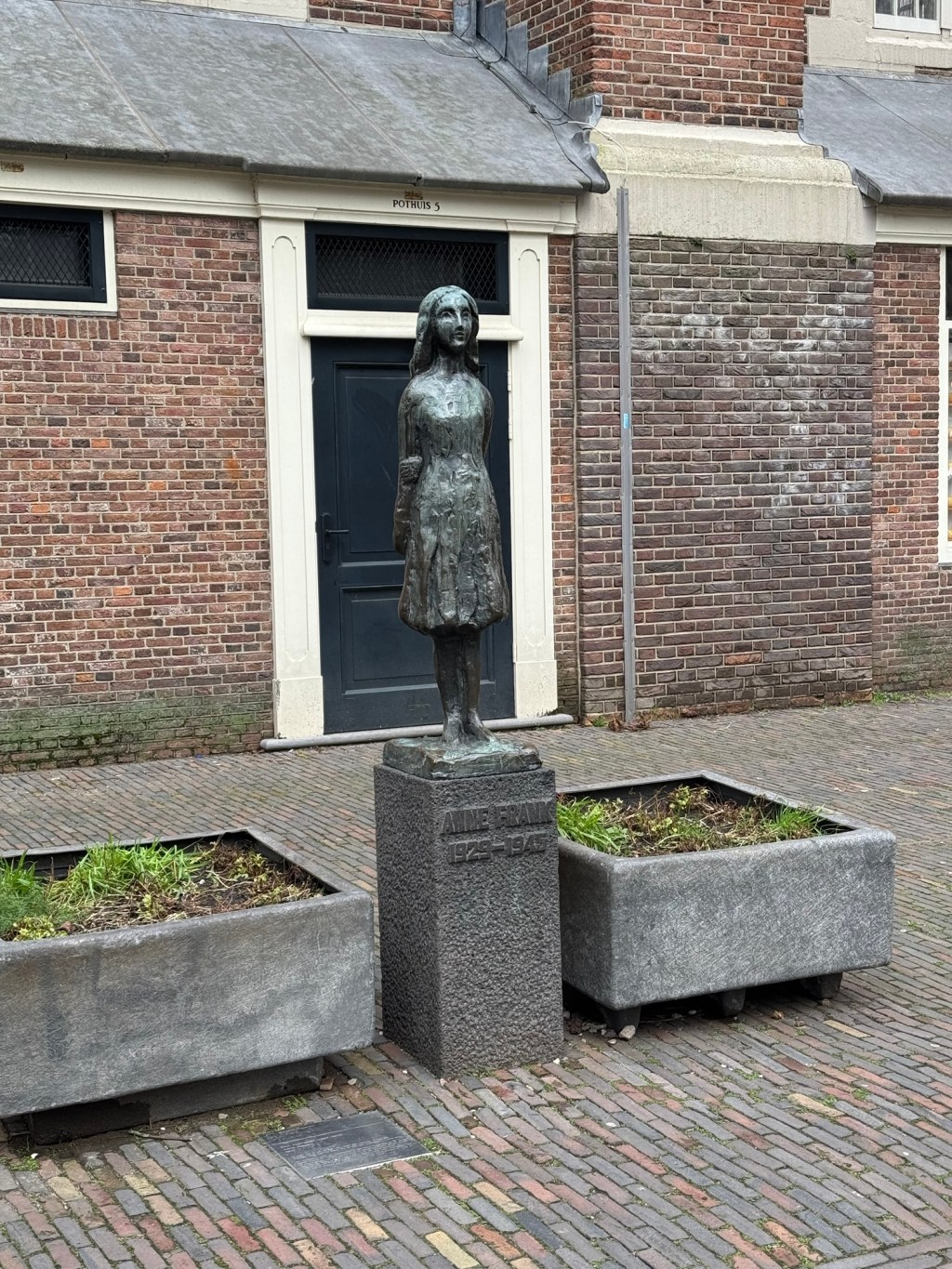
The alarm on my phone went off at seven this morning, but I ignored it. I was . Then, in panic, I remembered I had a 10:45 ticket to Anne Frank’s House. So at 9:10, I was drinking coffee across the road from the hotel and got ready for a thirty-minute walk to the House. I arrived at 10:30. It looked like I was one of the first to enter. Half an hour later, the place was packed.
I was offered an audio commentary and left my bag and coat free of charge with their concierge. Then, I was introduced to this remarkable young girl and her family. Yesterday, I was at the Van Gogh Museum, and there was a vibrant buzz about it. Today, it was solemn. People from around the world realised they were in an almost sacred place.
The Frank family spent two years hidden in the House’s rooms. Now, I can see it and walk through every room; even the walls have the same wallpaper. Everything is original. Anna Frank was a dreamer who dreamt of becoming a journalist and writer. Even though she died in a concentration camp, she is celebrated as one of the most influential human beings who ever lived. She left a powerful legacy and gifted us with an account of suffering, persecution, dreams, bravery, and hope; some of her words are printed on one of the walls as you enter the House: “One day, this terrible war will be over, and we’ll be people again, and not just Jews.” This says it all!
Then we came to the House that separated the hidden place, the annexe, from the warehouse. I did not realise that to enter the hidden rooms, a bookshelf filled with files acted as a door, hiding a small entrance. You wouldn’t have noticed the entrance; it was well hidden.


As I stood there looking at the real bookshelf, I thought of C S Lewis’s Narnia and the Wardrobe. The entrance to Narnia was through it, and suddenly, the children were transported to another world. I know that the analogy is not accurate. Still, when you go through the small hidden entrance and start climbing up the stairs, I realise that despite the time-lapse, I entered the world of Anne Frank, her family and friends who lived there, hiding from the terror of the Nazis. It became so real that the annexe rooms have not been changed; some of the furniture has gone, but the walls’ colours remain.
This experience became more real as I entered the room where her diaries and other writings were kept. There, separated from a glass cage, was Anne’s first diary. Her writing is neat, clear, and innocent.
Most of us know that the police and the Nazis found them. However, still today, no one knows who told the authorities, and they were taken to concentration camps where Anne died, together with her sister and her mother in another concentration camp; only her father survived.
I have much to reflect on this experience.
 D.L.
D.L. 
Leave a comment